
Prefer to listen, rather than read? Here you go.
 After working with hundreds of companies at different stages of growth, I’ve learned this:
Most business problems don’t start loud.
They start quietly — at the exact moment things begin to “work.”
That’s why I pay close attention to the people who were there at the beginning.
Calvin Chu was Employee #2 at Lyft — back when it was still an experiment fueled by instinct, belief, and long days that didn’t yet feel heavy.
He wasn’t just early.
He helped build the culture that made people care.
What follows isn’t a success story or a cautionary tale.
It’s something more useful than either.
It’s a close look at how growth actually feels from the inside — before anyone realizes what it’s costing. This interview was conducted in 2014 yet still carries valuable lessons.
Employee #2: Inside Lyft’s Rise — Before It Changed
In 2012, before the valuations, before the headlines, before the pressure — there were just a handful of people building something new.
Calvin Chu was Employee #2 at Lyft.
There were engineers. A small support team. And a belief:
“Make this world feel like a smaller place.”
He didn’t just watch Lyft grow.
He helped shape how it grew as a pioneering startup in the “sharing economy”.
Q: When you joined Lyft, what was it?
A: It was tiny. We had about 250 drivers in the first four months. Just engineers building the app and a small support team. The mission was to bring the community together — to make the world feel smaller by connecting people through transportation.
My role evolved over the 2 years I was there. I was still young - in my 20’s. But my real enjoyment and value was curating a great culture that kept employees happy.
Q: For people who don’t know — how did Lyft work in those early days?
A: It’s a ridesharing app. You open it and request a ride. It connects you to the nearest driver. You can see their photo, their location, their ETA. They can call or text you. You can see if they’re going the wrong direction. It felt safe and transparent. It was especially created to have drivers that made women feel safe from cab drivers who often hit on them.
But it wasn’t just about getting from point A to B. It was supposed to be fun.
Q: Fun?
A: Yeah. Drivers joined because they enjoyed meeting people. They would fist bump passengers. They had chargers. You could play your own music. We had themed rides — Candy Lyft, Disco Lyft. There was personality in it.
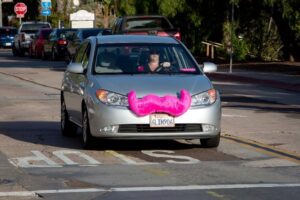 One marketing tactic was the pink moustache on the front of the cars — that was intentional. We didn’t explain it. It made people curious. It got people talking about it. If you Googled “pink moustache” from 2012 onward, it just became viral — and Lyft came up first.
Q: Did drivers mind putting a giant pink moustache on their car?
A: Part of our heavy screening practice was to mention the moustache. If someone was totally against it, that told us something. We were screening for that "fun" personality, not just driving ability.
You could be the best driver in the world — but if you didn’t have the right personality, it wasn’t a match.
The culture wasn’t decoration. It was the filter.
Q: You started as a driver?
A: Yes. Then I asked for more responsibility. I started interviewing driver applicants — phone interviews first, later in person. Eventually I built what we called the “Drive Team.” They were account executives who were the touchpoint for new drivers.
I hired and trained the first 20. Then I moved into operations and later opened up new territories.
Q: What were you looking for?
A: Playfulness. But also that they could get things done. Honestly, I usually made my decision in the first 30 seconds.
Q: Instinct?
A: Yeah. Intuition. You can feel people. But I always gave them more time. First impressions matter — but people deserve a chance.
The early team grew fast — but carefully.
Most customers came through word of mouth. In the first six months, it was essentially 100%. Drivers created such good experiences that passengers told their friends.
And sometimes, it went deeper than anyone expected.
Q: You once mentioned a story that stayed with you.
A: One of our drivers sensed something was wrong with one of his passengers. She seemed greatly disturbed. So, he turned off his phone and just sat and listened to her for an hour. A week later, we received a letter from the passenger who said she was going to kill herself that day. Because her Lyft driver had compassionately allowed her to express her struggles, she decided not to go through with it.
We had several stories like that.
That’s what Lyft was to me.
That sentence hangs there.
That’s what Lyft was to me.
 Q: How quickly did things start scaling?
A: Pretty quickly. After building the Drive Team, I left to help launch new cities — San Diego, Texas, Atlanta, Denver, LA. Someone else took over operations in the Bay Area. We were expanding fast.
Q: What tactics did you use for this strategic outreach and expansion?
A: I targeted tech companies because they had young employees who were more willing to try new ideas.
- We gave out Lyft swag which started word of mouth promotion.
- We went to bars after work and handed out free Lyft passes so people could get home safely.
- We advertised in Facebook, Pandora and Spotify to get a wide diversity of drivers.
- And several more tactics to build connections with people and companies.
*note from Allison: Before you just use these tactics, be certain your tactics align with your strategies because the situation for Lyft at this stage was already well funded with established operations. If you need a business evaluation, we'll take a look, so you don't lose time or money on tactics that don't work.
Q: What changes when you expand that quickly?
A: Growing pains. Extreme growing pains. Especially for early employees.
Q: Like what?
A: We told account executives they’d have six-month performance evaluations and could get raises. We wanted them to grow with us.
But once we started scaling, none of that happened. We didn’t run the evaluations. There were people there a year and a half with no raise.
Our management team was just dangling fruit.
There’s no anger in his voice when he says it.
Just clarity.
Q: Why didn’t it happen?
A: We were too busy in the growth frenzy. But also, our priority was numbers at that time. We were racing to win the market.
 Q: Did anything else begin to shift?
A: When you scale that fast, you start loosening things. Screening standards change. The focus becomes quantity.
At the time, it felt necessary.
Lyft was still growing.
Still expanding.
Still attracting funding.
But something subtle was happening beneath the surface.
The mission was still printed on the wall.
The energy inside the building was starting to change.
Q: When did you first feel it?
A: When numbers became the priority.
That’s where we leave it.
 DON'T MISS Part 2?
Calvin describes what happened next —
When growth accelerated faster than culture could keep up, and why he ultimately chose to leave.
Because companies rarely change all at once. They shift.
And sometimes, the people who built them are the first to feel it.
Lyft was still growing when Calvin noticed the shift.
Still expanding. Still winning market share.
Nothing was “wrong.”
And yet — something was changing.
Those moments are easy to miss when you’re inside them.
They feel practical. Necessary. Even smart.
 If you’re building something and quietly wondering whether your growth still feels like you — this next chapter in Part II will resonate.
And if you want a thoughtful and experienced outside perspective to get your growth moving forward or back on track, you can schedule a session with me when you’re ready.